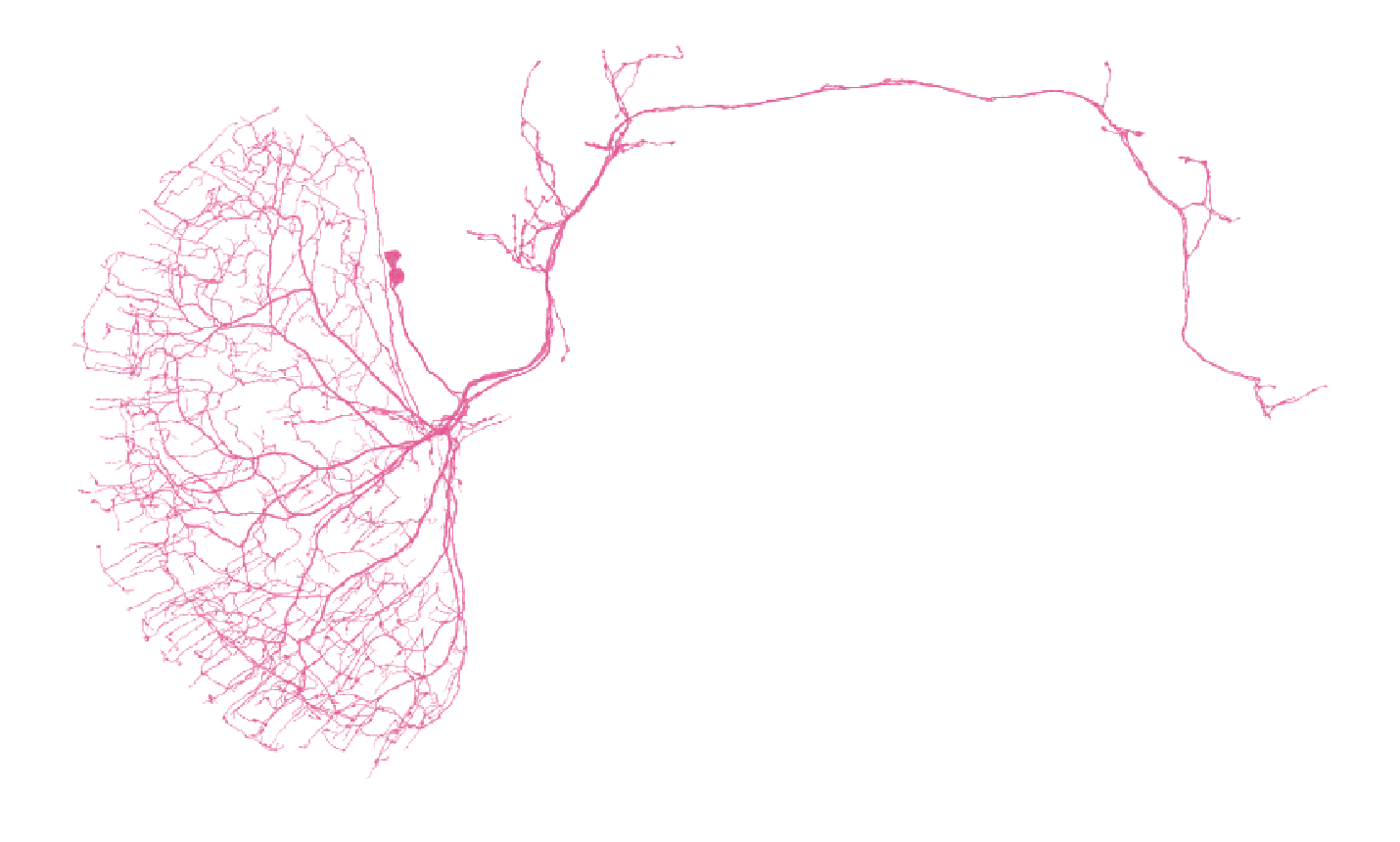
aMe12 neurons tile the optic lobe (left) and carry color information to the central brain, where they connect with neurons of the circadian clock.
Color cues for the circadian clock
Internal clocks need to be synchronized with the external world, integrating signals from the environment to infer time of day. In addition to intensity, the color content of light changes reliably during dawn and dusk, which gives the brain rich signals for entrainment. We are investigating how the fly's circadian system integrates spectral information to build a stable estimate of time. Building on our work on color-processing circuits, we use the connectome to identify circuits that relay chromatic signals to clock neurons and test how these inputs shape clock activity and circadian behavior.
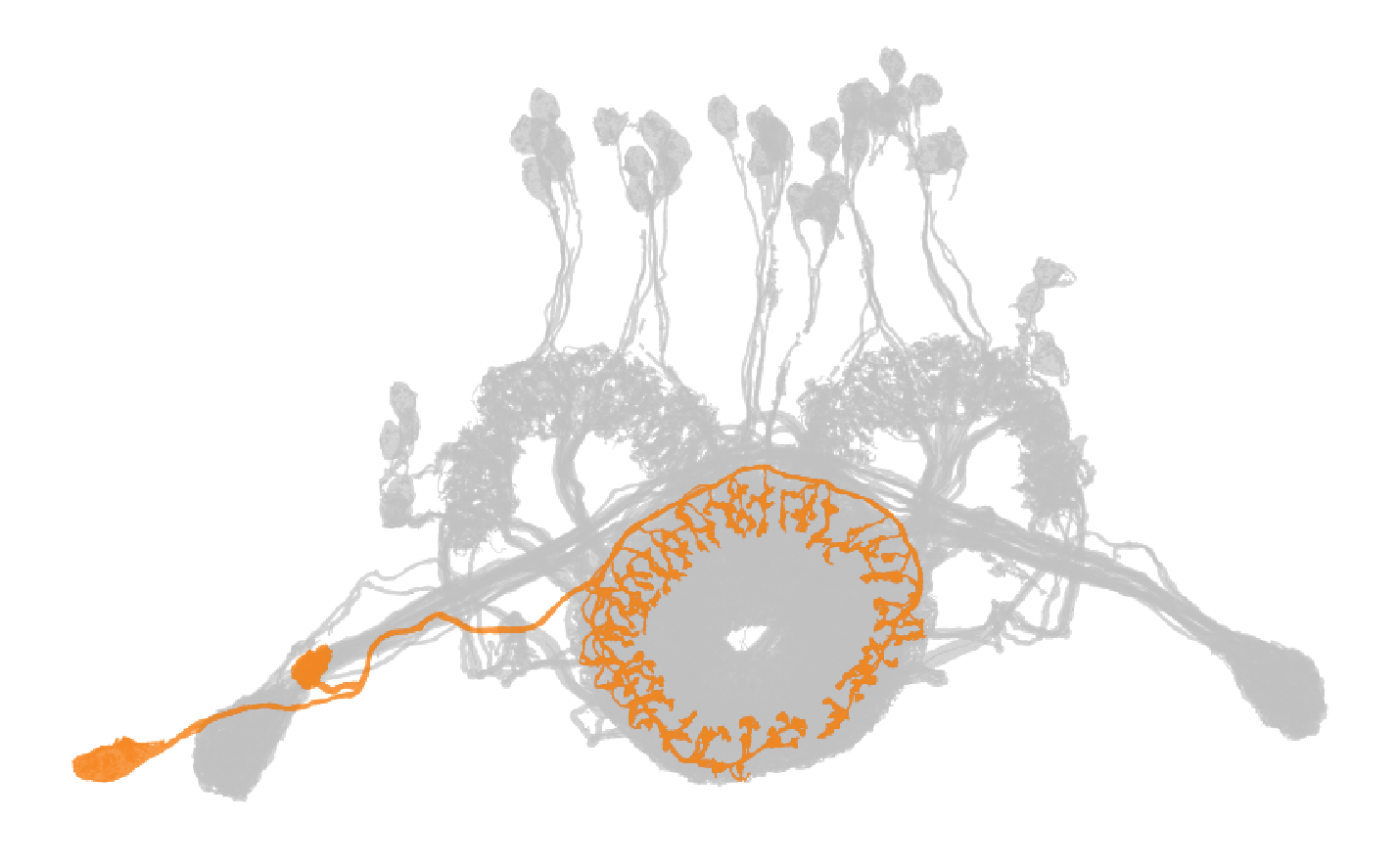
An ER4m ring neuron (orange) carries polarized light information to the compass of the fly (EPGs in grey).
Multimodal integration for navigation
Robust navigation requires a reliable sense of direction. Like mammals, flies possess an internal compass: a localized bump of neural activity in the central complex that tracks the animal’s heading direction. As the fly moves, the compass is updated by self-motion signals and anchored to the external world by sensory cues. Among the most widely used cues across insects are those from the sky. Sunlight scattered by the atmosphere produces stereotyped patterns of polarized light, color, and luminance that provide information about the sun’s position. However, each of these cues is inherently ambiguous or variable, making it insufficient on its own to reliably determine heading. We study how the fly brain combines information from multiple cues into a single, reliable heading signal. By studying this process, we aim to understand how neural circuits transform uncertain sensory information into a coherent and reliable representation of where one is in the world.
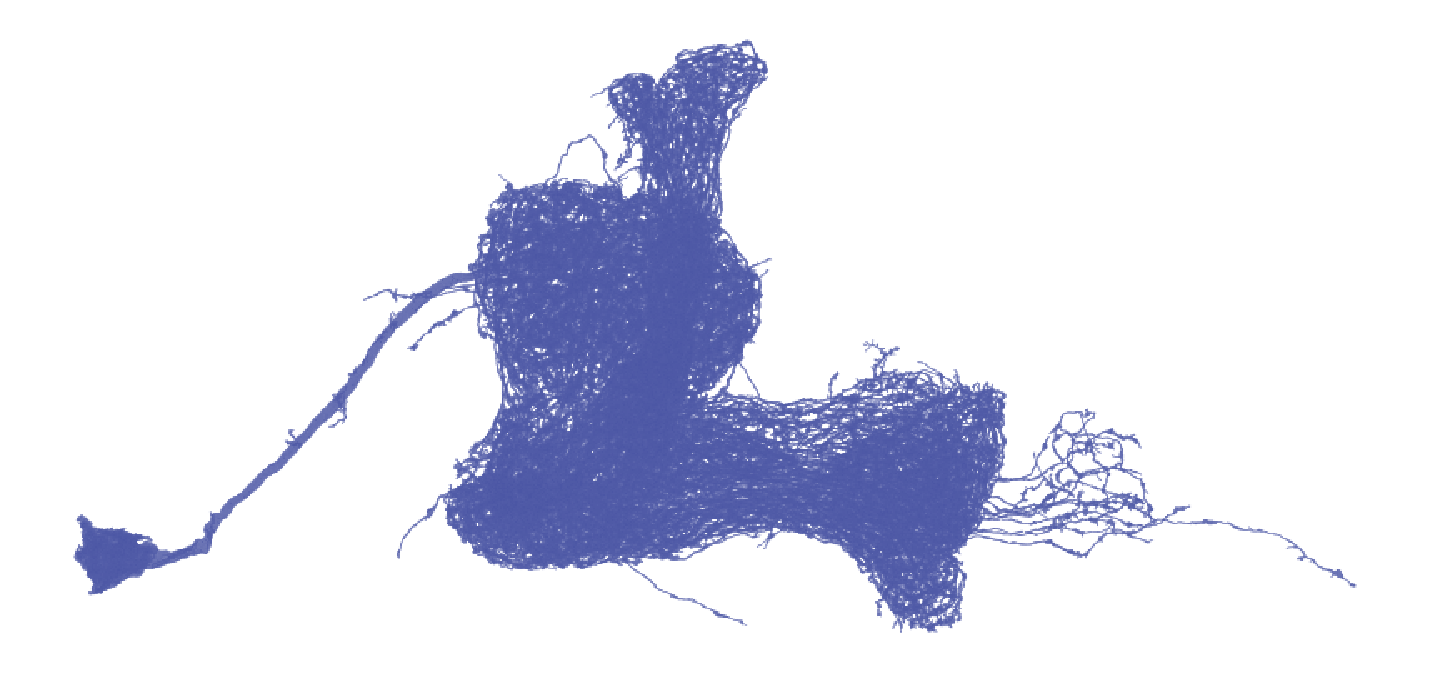
The giant inhibitory interneuron APL innervates all compartments of the mushroom body.
Visual Object Recognition
Animals must recognize and respond to the form of important objects in their environment to survive. Flies, in particular, have to distinguish whether a nearby object is a predator, a mate, or harmless clutter, and they must to do so quickly in visual scenes that are themselves changing. We want to understand how a small brain is able to accomplish this task. To do so, we have employed a combination of behavioral experiments, genetic screens, physiology, and connectomic analysis to identify the visual features that flies use to identify predators, as well as the cell types that represent those features. In parallel work, we are examining how these representations of objects are transformed into directed and specific actions by patterns of connectivity within the fly’s brain.
How vision shapes memory
In nature, animals learn in rich, multisensory environments. Animals must combine cues across the senses to transform sensory input and past experience into adaptive behavior. Yet much of what we know about how brains learn comes from experiments that isolate a single sense. In the Behnia lab, we study multisensory learning in the mushroom body, the fly’s center for associative memory. Visual and olfactory signals are carried by separate populations of Kenyon cells, the sensory input cells of the mushroom body, which feed into a shared learning architecture. This makes the mushroom body an ideal system for asking how learning circuits combine information across the senses, and how their structure shapes what an animal can learn. In the lab, we use in-vivo 2P imaging of mushroom body circuits to measure neuronal responses to visual, olfactory and multisensory cues to address this question. We pair neuronal imaging with behavioral assays to understand how visual and olfactory cues drive learning in flies. In collaboration with the Litwin-Kumar lab, we use our imaging and behavioral data to inform models of multisensory learning.
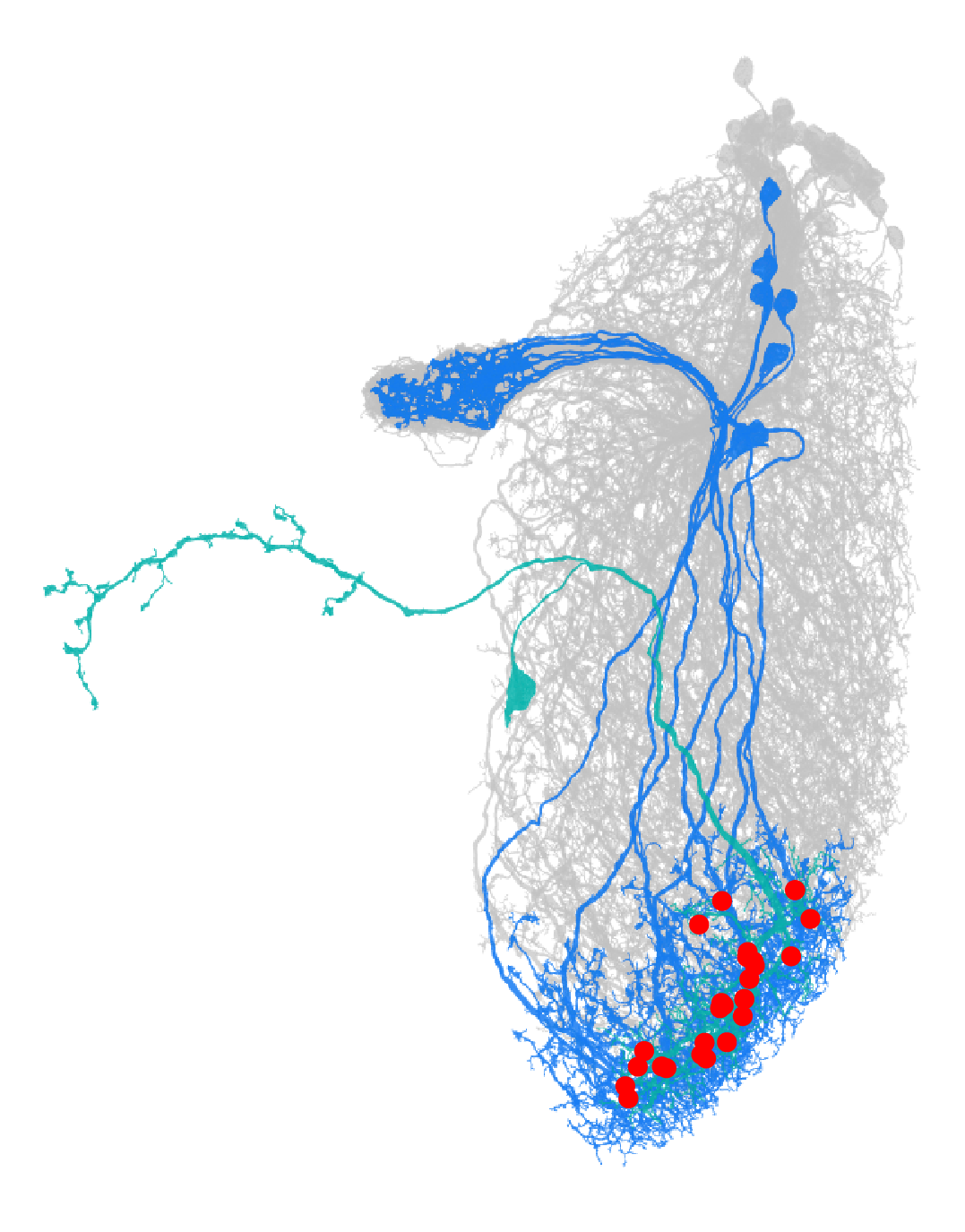
Synapses (red) between two visual projection neuron types: an LC31a neuron (teal) and upstream LC21 neurons (blue).